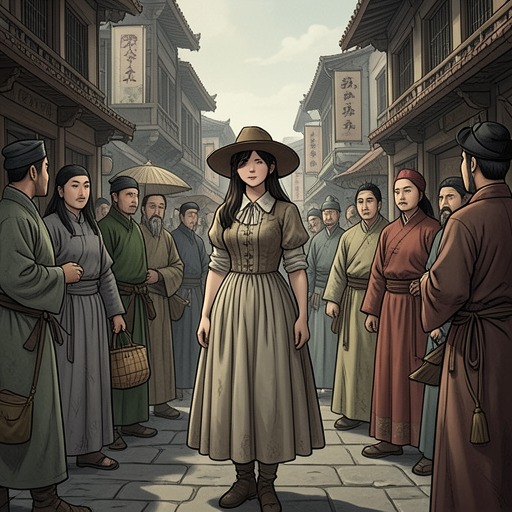
Chien Tan Tai Dong Zhen Zai Yi Yan
Loveboat, TaipeiChien Tan’s typhoon-relief benefit is the culminating public performance of the summer: a talent show expanded into a fundraiser for families in Taitung, with an auction alongside the stage program. The event gathers the book’s concerns with art, immigrant family obligation, cultural belonging, and chosen community into a single evening. Its emotional climax is Ever Wong’s original dance, “The Wanderer,” performed with Rick Woo before an audience that includes her father; its practical result is more than five hundred thousand New Taiwan dollars raised for relief.
From disaster to a public benefit
The benefit begins with the damage the students witness on their tour. As the typhoons intensify, their bus passes a Puyuma village submerged in muddy water, with only tin rooftops visible above the flood and debris scattered across the water. Later, Ever learns that Mei-Hwa’s home village in Taitung has been destroyed and that Mei-Hwa is leaving to help her parents. The disaster moves from a distant view through a bus window to a loss affecting someone in their circle.
Sophie Ha turns the group’s talent show into an opportunity to respond. She learns that a Singaporean acrobatic troupe has had to cancel at the National Theater because flights are disrupted by the typhoon. She persuades the theater to give the students its Friday-night opening, gets Li-Han to move the show and open it to the public, and arranges for the theater to promote the performance and allow admissions to be charged. Ever proposes donating the proceeds to Mei-Hwa’s family and the other families affected in her village; Rick suggests adding an auction so that people who cannot perform can contribute too. The event’s purpose thus expands from presenting student talent to directing both performance and donated objects toward disaster relief.
Organizing the evening
Sophie is the principal organizer, coordinating the venue, public access, theater promotion, and auction while managing the show with a clipboard. Two hours before the guests are due, she is already moving people into place. She also arranges for the theater to film the entire performance. The scale of the setting makes the students’ effort newly visible: Ever stands before three tiers of 1,498 velvet seats in a theater associated with performances by the Mariinsky Ballet, Broadway shows, and Yo-Yo Ma.
The auction links individual gifts to the collective cause. Xavier Yeh allows Sophie to offer his mural anonymously; he says he will sign it if someone buys it. The mural brings memories of the summer together in a single image: a green Chinese dragon, Chien Tan’s gates, dancers, Sun Moon Lake, and a river at Taroko Gorge where blue water populated by Asian American students meets gray water filled with black-haired families. Xavier describes the image as an analogy for the group. It becomes both a work of art offered for relief and a visual expression of the identities and histories converging at the event.
The program and its reversals
The evening’s program is not limited to Ever’s dance. The Gang of Five, who have already named and challenged stereotypes of Asian men, appear in the Ms. Chien Tan Beauty Contest. Marc Bell-Leong introduces the contestants; the audience cheers as Marc, Sam, David, Benji, and Peter perform in the contest, taking up the stereotype of the effeminate Asian man on their own terms. The Dragon, watching from the front row, joins in the applause. The staged spectacle makes the event’s broader idea of performance explicit: a stereotype can be turned into material for an act of self-definition rather than simply accepted as an imposed role.
The auction and the show’s relief purpose remain visible throughout the program. Sophie announces that the mural will be auctioned after the grand finale and repeats that all proceeds will go to families in Taitung affected by the typhoon. The students’ celebration and the disaster fund are not separate tracks: the audience’s response to the performance helps create the conditions for giving, while the announced destination of the proceeds keeps the evening oriented toward those who have lost homes and community.
“The Wanderer” and Ever’s performance
Sophie introduces “The Wanderer,” an original dance created and arranged by Ever, as the students’ international debut. The piece begins to “Lán Huā Cǎo,” with dancers forming three matching flower shapes under stage lights. At first their faces are neutral and their movements languid; as the music quickens, they remove black robes to reveal sapphire, emerald, and orange costumes, unfurling silk ribbons and blue fans. The changing choreography carries a story that Ever says has evolved through rehearsal and the addition of new elements.
Ever initially finds herself outside the dancers’ formation, unable to locate a place in its wave of blue, green, and orange. Her bo staff spins above her as she turns in red, catches it, and searches for where she belongs. Rick enters to the drums with a staff revolving to match hers. Their exchange becomes part of the choreography: she leaps at the apparent intruder, and their staves strike together before they move across the stage. When Ever’s foot slips on the waxed floor, Rick catches her at the waist and lifts her into an unpracticed series of turns. He eventually lowers her against him, and the applause brings them back to the public performance around them.
The duet changes the meaning of Ever’s position in the dance. What begins with her separated from the line ends in a partnered movement that neither dancer had rehearsed. In the encore, she and Rick retrieve their staves and perform a final fight across the stage as the drumming continues and the dancers form a semicircle behind them. Ever experiences the performance as a joining of parts of herself: she is glad to be partly Chinese and partly American, and understands herself as wholly herself as well. The dance gives that realization a public form without asking her to choose one identity over the other.
Audience, proceeds, and significance
The audience’s most personal response comes from Ever’s father. He rises from his wheelchair to his feet and continues clapping as the rest of the audience follows him into a standing ovation. His presence matters especially because Ever has made the performance, in part, an answer to her family’s expectations and to her father’s hopes for her. Onstage, the value of her dancing is no longer only her private conviction: he is there to witness it, and his standing applause becomes a visible acknowledgment.
The event’s material outcome is substantial. Xavier’s mural sells for US $7,100 to his father, who does not know that he has bought his son’s work. Sophie announces that the benefit has raised more than five hundred thousand New Taiwan dollars, given in the narration as US $16,000, for families in Taitung. Students and staff celebrate together as the performance ends; Li-Han, who had initially thought the arrivals were spoiled Americans, tells them he is proud of them. The benefit therefore closes the summer performance not simply as a showcase but as collective work: Sophie’s organizing, the performers’ labor, the bidders’ contributions, and the audience’s response all help turn an encounter with disaster into concrete support.